AI & Biosensors: How Emerging Allergen Detection Devices Are Transforming Safety Outside the Kitchen
Food allergy safety used to depend mostly on labels, memory, and a lot of caution. That is still true today, but a new wave of detection tools is changing what is possible outside the home kitchen. Restaurants, school cafeterias, travel settings, workplaces, and grocery aisles are all environments where people need faster answers, not just better intentions. This is where AI-enabled biosensors, portable analyzers, and smartphone-connected tests are starting to matter.
The big promise is simple: identify allergens in real time, without sending samples to a lab, and do it in a form that is practical enough to use in daily life. Some devices are built for professional environments, some are designed for consumer use, and some are still near-market innovations. But they all reflect the same shift. Allergy detection is moving from slow, centralized testing toward compact, on-the-spot decision tools.
Why Real-Time Allergen Detection Matters Outside the Kitchen
Outside the kitchen, the challenge is not just whether an ingredient list looks safe. It is whether food was shared with the same utensils, whether a sauce was thickened with an unexpected ingredient, whether a dessert contains hidden milk or egg, or whether a packaged snack is safe after reformulation. The gap between what a label says and what a person actually eats can be very small, and for people with severe allergies, that gap matters a lot.
Real-time detection devices are attractive because they can support quick decisions in the exact moment they are needed. A caregiver at a school lunch table, a restaurant manager checking a meal before service, or a traveler deciding between packaged foods can all benefit from a tool that gives an immediate answer. Even a small reduction in uncertainty can improve safety and confidence.
This is also why the category has expanded beyond traditional lab-style testing. In the real world, people need devices that are portable, fast, and easy to interpret. That practical pressure is driving a whole generation of hardware and software designed to work in the field rather than in a controlled laboratory.
What’s Driving the New Generation of Allergen Tech
Several trends are pushing allergen detection forward at the same time. First, materials science has improved. Researchers now use nanomaterials, modified electrodes, and engineered recognition layers to increase sensitivity. Second, mobile computing has become powerful enough to handle image analysis, pattern recognition, and app-based readouts on a phone. Third, there is stronger demand for tools that can be used where food is served and eaten, not just where it is prepared.
The research pipeline reflects that shift. Portable formats now include lateral flow assays, paper-based microfluidics, dual-mode sensors that combine colorimetric or fluorescent readouts with electrochemistry, microfluidic chips, and smartphone-integrated biosensors. According to a recent review of portable analytical formats, these technologies are among the most active near-market and research directions for allergen detection, especially when fast results and compact hardware are priorities: https://www.sciencedirect.com/science/article/pii/S0924224424001614
At the same time, developers are trying to make these devices more useful in complex food settings. That means handling sauces, mixed dishes, plant-based milks, bakery items, and processed foods where allergen proteins may be harder to detect. The best new devices are not just aiming for sensitivity. They are also aiming for usability under real conditions.
How AI-Enabled Biosensors Actually Work
At a basic level, a biosensor combines three parts: a recognition element that binds to the allergen, a transducer that converts that binding into a measurable signal, and a readout system that makes the result understandable. The recognition element might be an antibody, an aptamer, or a molecularly imprinted polymer. The signal might be electrical, optical, fluorescent, or color-based.
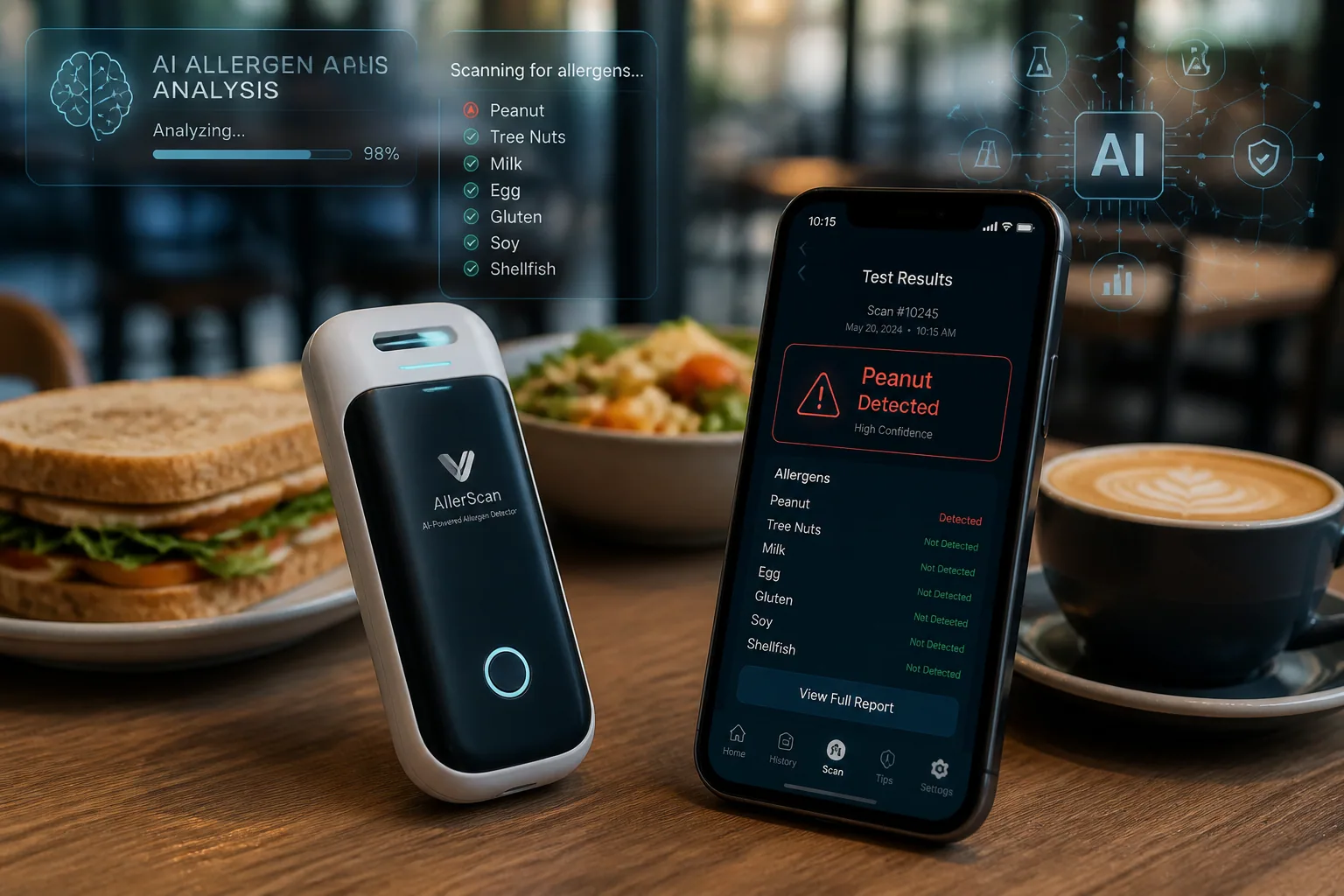
AI comes into the picture when the device needs to interpret a noisy signal, image a test strip, compare a result against calibration data, or classify patterns from a smartphone camera or connected potentiostat. In practical terms, AI can help improve the usability of the device by turning complex signal data into a simpler yes or no, or by helping the system compensate for lighting, background noise, or user handling differences.
That said, AI does not remove the core biological limits of detection. If the sample is poorly collected, if the allergen is unevenly distributed, or if the protein has been altered by processing, the smartest algorithm still depends on a meaningful signal to analyze. AI can improve interpretation, but it cannot magically recover what the sample never contained or what the assay could not bind.
Electrochemical Sensors: Fast Signals From Tiny Samples
Electrochemical biosensors are one of the most promising formats because they can be fast, compact, and highly sensitive. They usually rely on screen-printed electrodes, gold or carbon-based surfaces, and nanomaterials like graphene or metal nanoparticles to boost performance. A recognition event on the electrode changes the electrical signal, which can be measured quickly with portable hardware.
One strong example is the iEAT2 electrochemical biosensor system, which can detect multiple allergens at once, including gliadin, Ara h1, and ovalbumin, in real foods. It completes allergen extraction and detection in about 15 minutes and achieves detection below known allergic reaction thresholds. That combination of multiplexing and speed is exactly why electrochemical platforms are so exciting for real-world use: https://pubmed.ncbi.nlm.nih.gov/39832405/
Another useful example comes from Allergy Amulet’s rapid electrochemical sensor using molecularly imprinted polymers. In one study, it correctly identified soy allergen presence or absence in 42 food products covering more than 300 ingredients, and it matched commercial lateral flow devices in both store-bought and restaurant meals with high accuracy: https://pmc.ncbi.nlm.nih.gov/articles/PMC8531013/
The appeal of electrochemical sensing is easy to understand. The sample size can be small, the hardware can be portable, and the measurement can happen quickly. But like any advanced method, performance depends on calibration, sample preparation, and the complexity of the food matrix.
Fluorescent and Optical Detection Devices to Watch
Optical and fluorescent systems detect changes in light rather than electricity. These approaches can be very sensitive and are often easier to pair with visual or camera-based readouts. In practice, they can show whether a target protein is present by producing a glow, a color shift, or an optical signal that the device can quantify.
One notable near-market example is the RESAS project, which aims to detect small allergen concentrations below 10 ng/g of food sample, with final readouts in about 5 minutes, using an optical biosensor substrate integrated into a handheld device. That is an impressive target because it combines speed with an extremely low detection threshold: https://cordis.europa.eu/project/id/101062517/reporting/fr
A related direction is smartphone-based imaging surface plasmon resonance. In one portable system designed to detect total hazelnut protein in plant-based milks, the lowest tested concentrations were 0.625 µg/mL, with limits of detection down to 0.04 to 0.53 µg/mL depending on the milk type. That matters because beverages and emulsified foods are notoriously tricky matrices, and a portable imaging approach can be adapted to settings where traditional lab testing would be too slow: https://research.wur.nl/en/publications/a-portable-smartphone-based-imaging-surface-plasmon-resonance-bio/
Paper-Based and Low-Cost Test Formats for Everyday Use
Not every user needs a sophisticated connected instrument. Sometimes the most useful device is the one that is cheap, fast, and disposable. Paper-based tests and lateral flow assays remain important because they are relatively simple to run, easy to transport, and often more affordable than advanced electronic systems.
The trade-off is that lower cost often means less quantitative precision. A paper strip may tell you whether an allergen is likely present, but it may not give a detailed concentration reading. That can still be very useful in a school or restaurant environment, where the main question is whether a product or surface should be considered unsafe.
This is also why hybrid designs are becoming more interesting. Some new systems combine test strips with camera-based interpretation or dual-mode sensing, so users get the simplicity of a strip and the improved analysis of software. The goal is not to replace every conventional assay, but to make quick testing more realistic outside the lab.
Smartphone-Integrated Sensors and App-Based Readouts
Smartphones have become a natural interface for biosensors because they already include cameras, connectivity, and enough computing power to support image analysis. App-based readouts can guide the user through the process, capture the result, store history, and in some cases help standardize interpretation across different users.
For allergy detection, that matters because user error is one of the most important practical issues. A phone can help with timing, scanning, and record keeping, while the app can display whether the result is clear, borderline, or invalid. Some systems even use a mobile potentiostat or imaging module to perform the measurement itself, turning the phone into part of the instrument rather than just a display.
There is still a catch. Smartphone systems can depend on stable lighting, clean optics, careful positioning, and software that has been trained on diverse real-world samples. That means a good app can improve usability, but it also creates new failure points if the calibration is weak or the image conditions vary too much. In other words, convenience is real, but so is the need for validation.
Which Allergens Today’s Portable Devices Can Detect
Portable devices today are often designed around a limited panel of major allergens rather than every possible trigger. Common targets include peanut, tree nuts, milk, egg, wheat, soy, shellfish, fish, gluten-related proteins, and sometimes specific proteins such as Ara h1, gliadin, ovalbumin, or hazelnut proteins. That makes sense because these allergens are both clinically important and analytically common in foods.
The iEAT2 platform demonstrates multiplex detection of gliadin, Ara h1, and ovalbumin in real foods, which is a strong sign that multi-allergen testing is becoming more feasible. Likewise, the portable iSPR hazelnut sensor shows that a focused device can be built around one key allergen when a specific use case demands it.
Still, no portable device can cover every scenario equally well. A product might detect peanut reliably but struggle with highly processed milk proteins, or it might perform well in liquids but less well in dense baked goods. The more specialized the assay, the more important it is to understand exactly what it can and cannot measure.
How Reliable Are These Tools in Real-World Conditions?
Reliability is the central question for anyone considering these devices. A sensor can look excellent in a controlled lab study and still be challenged by real-world food matrices, inconsistent sampling, or imperfect handling. This is why validation in store-bought meals, restaurant foods, and complex commercial products is so important.
The best signs of reliability come from testing across many different food types, not just one neat laboratory sample. For example, the Allergy Amulet sensor was evaluated across 42 food products spanning more than 300 ingredients. That kind of breadth is useful because it starts to show how the system behaves in realistic settings, not just ideal ones.
Even so, users should think of these tools as decision support, not absolute truth. If a device says a food is safe, that does not eliminate risk from cross-contact, contamination after testing, or allergen levels below the assay’s detection limit. If it says unsafe, that result should be taken seriously, but the test may also need confirmation if the sample was difficult or the result was borderline.
The Biggest Limitations: Cross-Contact, Complex Foods, and False Confidence
One of the hardest problems in allergen detection is cross-contact. Allergens may be present in tiny, uneven amounts, and those traces can be enough to cause a reaction for sensitive individuals. A sample taken from one part of a dish may not represent the whole plate, especially in mixed foods or heavily processed products.
Another challenge is matrix interference. Fats, polyphenols, viscosity, texture, and protein denaturation during cooking or processing can all affect detection. According to recent research, these issues can contribute to false negatives or false positives in many devices, especially in complex or highly processed foods: https://www.sciencedirect.com/science/article/abs/pii/S3050475926003738
This is where false confidence becomes dangerous. A device that appears simple to use may encourage users to rely on a single measurement when the actual food environment is messy and uneven. The safest mindset is to treat any result as one more input, not the final authority. The more the food is mixed, processed, or handled by multiple people, the more important it is to combine the result with ingredient review, staff communication, and established safety practices.
Cost, Portability, Speed, and Ease of Use Compared
These devices are usually designed around trade-offs. High sensitivity often means higher cost and more careful calibration. Cheaper paper-based or colorimetric tests may be fast and easy to carry, but they often provide less quantitative detail. Smartphone-linked systems improve convenience, but they can add dependence on software quality, battery life, camera conditions, and app support.
Speed is another major differentiator. Some systems aim for a result in about 5 minutes, like the RESAS handheld optical project, while others, like iEAT2, can complete extraction and detection in around 15 minutes. That is already much faster than sending a sample to an external lab, but it may still be too slow for some situations where a decision has to be made instantly.
Portability matters just as much. A truly useful device for restaurants, schools, or travel should be small enough to carry, robust enough to survive daily use, and simple enough that staff or caregivers can use it correctly under pressure. In practice, the best tool is often the one that balances acceptable accuracy with a workflow people will actually follow.
Best Use Cases for Individuals, Caregivers, Restaurants, and Schools
For individuals and caregivers, the most useful tools are the ones that support quick decisions in everyday life. That might mean checking a packaged snack, verifying a new product, or confirming whether a menu item seems worth further caution. For these users, ease of use and fast interpretation often matter more than technical sophistication.
In restaurants, the value is different. Staff may need a tool that helps verify ingredients, demonstrate diligence, and reduce the risk of serving a dangerous meal. In schools, the main goal is often to protect children consistently, which means devices must be simple, durable, and easy to integrate into routines.
Professional environments also need clear protocols. A detection device is only helpful if staff know when to use it, how to collect a sample, what to do with a positive result, and how to communicate uncertainty. The device should support a safety process, not replace one.
What Features to Look for Before Buying an Allergen Detection Device
If you are evaluating a device, the first question is not how advanced it sounds. It is what problem it solves. Look at the allergens it can detect, the sample types it supports, the detection limit, and whether performance has been validated in real foods rather than only ideal lab samples.
You should also ask how results are displayed. Is the output binary, semi-quantitative, or quantitative? Does the device require a separate reader, a phone, or a cloud connection? Is the test disposable, reusable, or both? How long does it take from sample to result, and how much training does it need?
It is also wise to think about contamination control. A great sensor can still produce bad results if the sample spoon, swab, or surface is contaminated. Packaging, handling instructions, and cleaning protocols matter almost as much as the detection chemistry itself. Finally, consider whether the company provides clear validation data and updates its product responsibly.
How to Combine High-Tech Tools With Practical Allergy Safety Habits
The smartest way to use allergen detection technology is as part of a broader safety system. That system still starts with reading labels carefully, confirming ingredients with staff, avoiding cross-contact, and knowing how to respond if something goes wrong. A device can increase confidence, but it should never replace good judgment.
For many people, the best workflow is layered. First, review the label or menu. Second, ask about preparation and shared equipment. Third, use a detection tool if the situation is uncertain and the product or meal is testable. Fourth, interpret the result in context. This layered approach is especially important because even strong sensors have limits in messy, processed, or mixed foods.
That is where a practical scanner like Bokha can fit naturally into the broader picture. As a mobile app available on iOS and Android, it lets users scan product barcodes and discover allergens in less than a second, including 13 allergens, traces, and additives. For grocery shopping and quick checks on packaged foods, it can save time and reduce friction at the point of decision: https://findthe.app/bokha
What’s Next: Near-Market Innovations and the Future of Personal Allergen Detection
The future of allergen detection is likely to be more portable, more connected, and more automated. Near-market systems are already moving toward handheld optical biosensors, smarter smartphone imaging, dual-mode readouts, and better integration with simple disposable test formats. Some projects are clearly aimed at everyday use rather than laboratory demonstration.
A good example is the James Dyson Award project for a Portable Multi-allergen Test, which combines test strips with AI imaging for everyday use outside labs. It reflects the direction the field is heading: compact devices that reduce user friction while improving interpretability and speed. The design challenge is not just making detection possible, but making it reliable enough for real routines: https://www.jamesdysonaward.org/en-US/2026/project/portable-multi-allergen-test
Over time, we can expect better multiplexing, improved sample handling, and stronger integration with mobile software. But the most important change may be behavioral. As people become more comfortable using these tools, allergen detection could become a normal part of travel, dining, caregiving, and school safety. That would be a major shift from reactive allergy management to proactive risk reduction.
For now, the key takeaway is balanced optimism. AI-enabled biosensors are making allergen detection faster, smaller, and more usable than ever before. They are not perfect, and they are not a substitute for careful habits. But for the first time, many of the best tools are becoming practical enough to leave the lab and help people make safer decisions in the real world.