A Day in the Life with Multiple Food Allergies: Real-World Challenges and How a Scanner App Can Help
Living with multiple food allergies is not just about avoiding a few ingredients. It is about constantly scanning, questioning, and planning around risk in ordinary moments that most people do not think twice about. Breakfast, work lunches, grocery runs, social events, and late-night cravings can all become decision points that carry real consequences. For many people, this is a daily mental load, not an occasional inconvenience.
That burden is more common than many realize. Research suggests that about 40% of U.S. children and nearly 48% of U.S. adults with convincing IgE-mediated food allergies report allergy to multiple foods, and multiple-food allergy is linked to greater healthcare use and psychosocial burden. Another U.S. estimate found that around 10.8% of adults have at least one convincing food allergy, and 45.3% of those adults are allergic to multiple foods. Food allergy is also widespread overall, with the CDC reporting that 6.7% of U.S. adults had a diagnosed food allergy in 2024. Source
Why Multiple Food Allergies Make Everyday Life So Complicated
When someone is managing dairy, peanuts, and gluten at the same time, the challenge is not simply ingredient avoidance. It is the overlap between allergens, hidden ingredients, shared equipment, changing formulations, and uncertain labeling. A product might be safe one month and risky the next if a recipe changes. A meal that looks harmless can still contain a trace allergen or be exposed to cross-contact during preparation.
The emotional impact is real too. Studies show that children with multiple food allergies and their caregivers experience a steadily increasing psychosocial burden with each added allergen, even after accounting for other factors. In adults, wheat, soy, and milk allergies are associated with larger decreases in quality of life, and key risk factors for burden include younger age, lower income, a history of severe reactions, needing an epinephrine autoinjector, and having multiple food allergies. Source
This is why food allergy management can feel exhausting. It is not only about physical safety. It is also about the constant need to anticipate problems before they happen.
Breakfast: The Hidden Risks in Smoothies, Cereals, and Grab-and-Go Foods
Breakfast is often where the day starts to feel complicated. A smoothie may seem like a safe shortcut, but yogurt bases can hide dairy, protein powders may contain milk or soy, and granola toppings often bring peanut or tree nut risks. Even a simple cereal can be tricky if it contains gluten, is processed in a shared facility, or includes vague precautionary wording on the box.
Grab-and-go foods are especially challenging because they are designed for convenience, not careful scrutiny. Muffins, breakfast bars, and packaged pastries can contain multiple allergens in one serving. For someone trying to leave the house quickly, the problem is not only finding a safe option but having enough time to verify it before the train arrives or the meeting starts.
This is where routine matters. Many people with multiple allergies learn to build a safer breakfast rhythm around a small set of trusted foods, repeated ingredients, and backup options kept at home or in a bag. Predictability can be just as valuable as variety.
Commuting and On-the-Go Snacks: Staying Safe Away from Home
The commute is one of the least glamorous but most important allergy risk zones. Hunger hits at the wrong time, and the easiest available snack is often the least certain. Vending machine items, coffee shop pastries, and convenience-store snacks are often packed with cross-contact concerns, and many labels are hard to check in a hurry.
People with multiple food allergies often become experts at carrying backup snacks because they know that being hungry makes decision-making harder. A trusted snack in a backpack or glove compartment can prevent a rushed purchase that turns into a risky one. It also reduces the temptation to “just try it” when the day gets long.
The goal is not perfection. It is lowering the number of moments where you are forced to choose between convenience and safety under pressure.
Lunch Break Stress: Work, School, and Cross-Contamination Concerns
Lunch can be one of the most stressful parts of the day because it often involves food that was prepared by someone else, stored near other foods, or brought in by coworkers and classmates. Even if a dish does not contain a listed allergen, cross-contamination can still make it unsafe. Shared utensils, communal cutting boards, and buffet lines all increase uncertainty.
This is also where the social pressure can intensify. People may ask why you are not “just having a bite,” or they may downplay the issue because the food looks harmless. Qualitative studies describe how people with multiple food allergies often feel a loss of spontaneity, stress and anxiety in social settings, and a need to constantly prove their allergy to others. Source
A practical approach is to normalize bringing your own lunch or keeping shelf-stable safe items at work or school. That is not being difficult. It is being prepared.
Grocery Shopping with Multiple Allergies: Why Labels Aren’t Always Simple
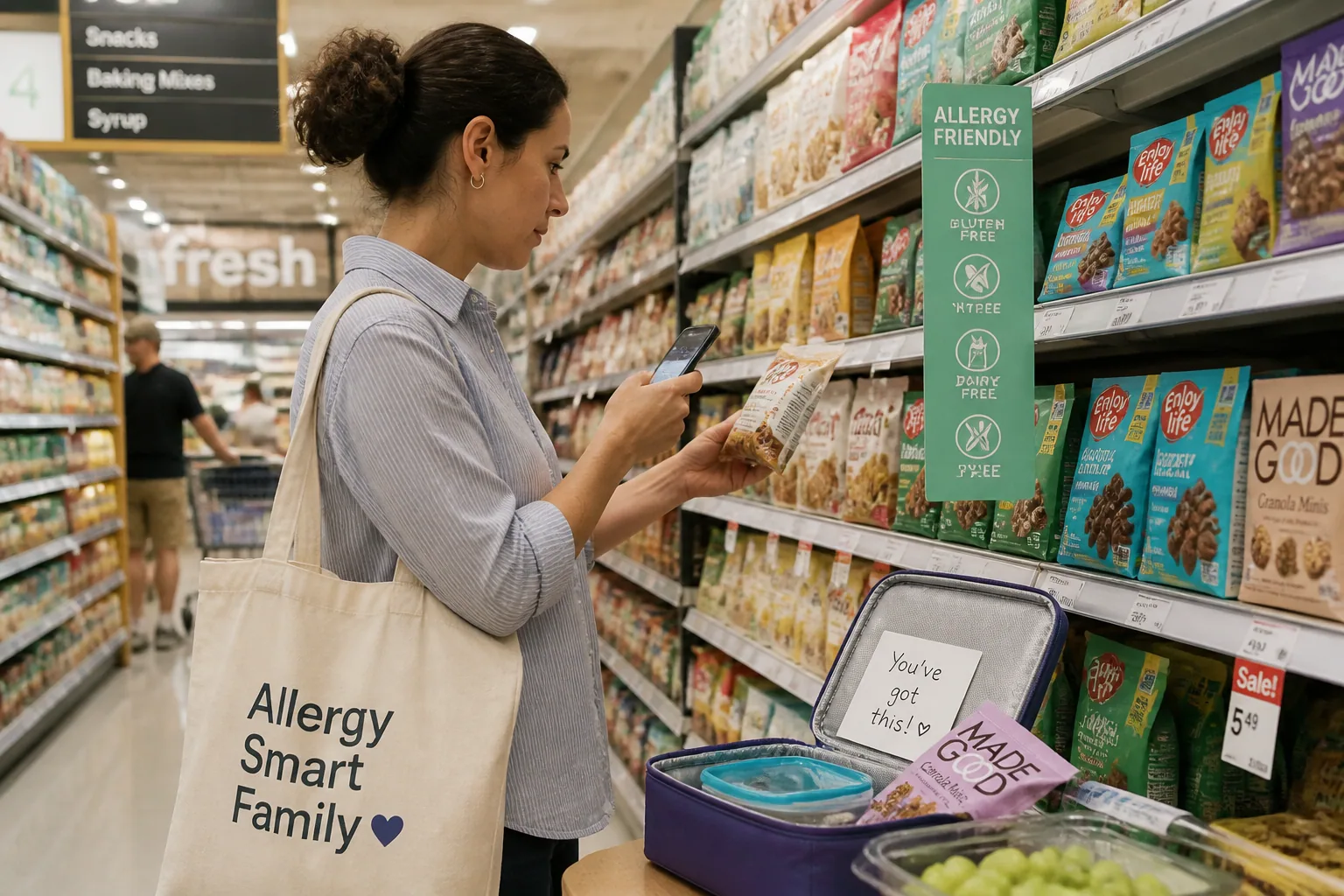
Grocery shopping should be straightforward, but for someone with multiple food allergies, it can feel like reading a series of riddles. Ingredient lists are not always intuitive. Terms like casein, whey, malt, or modified starch may require extra knowledge. Then there are precautionary allergen labels such as “may contain,” “manufactured on shared equipment,” or “shared facility,” which can be especially frustrating because they do not reliably indicate the same level of actual risk.
Research shows that label-reading is particularly frustrating precisely because manufacturers use different voluntary precautionary allergen labels, and those labels do not consistently map to contamination risk. In addition, precautionary allergen labels are not required by the FDA, cross-contamination control practices vary, and formulation changes can make previously tolerated items unsafe. Source
That means grocery shopping is not just shopping. It is surveillance. It is comparing labels, checking packaging carefully, and re-checking the foods that were safe last week. It can be mentally draining even before you reach the checkout line.
How a Scanner App Like Bokha Can Save Time and Reduce Mental Load
This is where a scanner app can make everyday life easier. Bokha, available on iOS and Android, lets you scan product barcodes and discover allergens in less than a second. It detects 13 allergens, including lactose, gluten, peanut, egg, soy, fish, shellfish, tree nuts, wheat, mustard, celery, mint, and sulphites, along with traces and additives. You can learn more here: https://findthe.app/bokha
In practical terms, this kind of tool helps reduce the time spent decoding labels aisle by aisle. Instead of squinting at tiny ingredient panels, you can quickly identify products that are more likely to fit your needs and move on with your day. That matters because decision fatigue is part of the allergy experience too.
Research on scanner apps suggests they can increase purchase intentions toward healthier or safer foods compared with relying only on front-of-pack labels or no information at all, although real-world shopping effects can vary. Even so, the promise is clear: fast access to allergen and nutrition data can reduce friction and make safer choices feel more manageable. Source
Social Events and Dining Out: How to Ask the Right Questions Without Feeling Awkward
Social events often require the most emotional preparation. At a dinner party, wedding, birthday, or restaurant, you may need to ask what is in the food, how it was prepared, whether there was cross-contact, and whether substitutions are actually safe. That is a lot to negotiate while also trying to be relaxed and social.
It helps to remember that clear communication is not rude. It is protective. A short message to a host in advance can be easier than trying to manage the situation on arrival. In restaurants, it can help to ask specific questions rather than broad ones. Instead of asking whether something is “allergy friendly,” ask about ingredients, prep surfaces, shared fryers, sauces, and garnishes.
The reality is that many people with multiple food allergies feel they have to advocate for themselves repeatedly. That can be tiring, but it also becomes a skill. The more specific and calm the question, the easier it often is for others to respond well.
Meal Prep, Backup Snacks, and Other Everyday Coping Strategies
A safer routine usually depends on a few simple systems. Meal prep is one of the most effective. Cooking larger batches of meals you know are safe can reduce reliance on uncertain food during busy days. It also means fewer last-minute decisions when you are tired or distracted.
Backup snacks are equally important. Keep them in your bag, car, desk, or locker so that you are never fully dependent on whatever happens to be available. Shelf-stable options can be especially helpful when travel, overtime, or errands stretch longer than expected.
Other useful habits include saving a list of trusted products, taking photos of ingredient labels for reference, and creating a simple script for talking about allergies in restaurants or at social events. These systems do not eliminate risk, but they can lower the effort required to manage it.
The Emotional Labor of Constant Vigilance
One of the hardest parts of living with multiple food allergies is that the work never really stops. You are not only deciding what to eat. You are also evaluating trust, reading other people’s behavior, and staying alert in spaces that are supposed to feel ordinary and enjoyable. That kind of vigilance can wear people down.
Research shows that multiple-food allergy is associated with increased psychosocial burden. Qualitative studies also describe the loss of spontaneity, the anxiety of social events, and the feeling of needing to justify your choices. For children and caregivers, the burden rises with each additional allergen. For adults, the same pattern can show up as fatigue, hypervigilance, and the sense that food is always a project rather than a pleasure. Source
This is why support matters. Helpful friends, informed coworkers, and responsive restaurants can make a major difference. So can tools that reduce the number of moments where you have to do everything manually.
Bedtime Cravings, Last-Minute Choices, and Building a Safer Routine
Bedtime is when good intentions often collide with tiredness. A craving for something sweet or salty can lead to the same question you faced all day: what is safe, and what is worth the risk? Late-night snacking is especially tricky because labels are harder to read when you are exhausted, and the easiest option is often the one you have not checked carefully enough.
A safer nighttime routine can help. Keep a short list of trusted snacks, stock them consistently, and make it easier to choose before hunger becomes urgency. The more you can turn safety into routine, the less energy you spend fighting uncertainty at the end of the day.
That is really the larger lesson of living with multiple food allergies. The goal is not to control every possible risk. The goal is to create enough structure, support, and speed that daily life becomes broader and less stressful. With better planning, clearer communication, and tools like Bokha, more moments can feel possible again.